- Welcome to Stranger Things.

Recent posts
#1
Shincheonji: The Cult Of Lee Man-hee: Articles, Links & Resources / Re: Lee Man-hee & Shincheonji:...
Last post by Peter Daley - October 05, 2026, 02:05:48 PMFebruary 28-29, 2020
Feb. 28: Investigations into Shincheonji Church of Jesus the Temple of the Tabernacle of the Testimony in Singapore (Singapore Ministry of Home Affairs Press Release)
Feb. 28: Investigations into Shincheonji Church of Jesus the Temple of the Tabernacle of the Testimony in Singapore (Singapore Ministry Of Home Affairs)
Feb. 28: Lee Man-hee is Already Banned From Leaving The Country - Charged With Embezzlement (Channel A - Pagoda/Naver Translation Available Here)
Feb. 28: South Korean Cult's Activities in Singapore Mirror Its Shadowy Operations Elsewhere (The Straits Times)
Feb. 28: About 1,600 Shincheonji Followers on Self Quarantine (Yonhap News)
Feb. 28: South Korean Officials Search For Almost 3,000 Religious Group Members (CNN)
Feb. 28: Secretive Cult Behind the Korean Coronavirus Outbreak has Branches in Australia (The Age & Sydney Morning Herald)
Feb. 28: Minister Shanmugam on The Singapore Chapter of The South Korean Shincheonji Cult Being Investigated by MHA (Channel News Asia)
Feb. 28: 1,638 Shincheonji Members with Coronavirus Symptoms under Self-Quarantine (KBS World Radio)
Feb. 28: Who is Lee Man-hee and Why is his Secretive Church Linked to Half South Korea's Coronavirus Cases? (South China Morning Post Video)
Feb. 28: Gov't Tracks Down Shincheonji Adherents & Many Feel Ill (Korea JoongAng Daily)
Feb. 28: MHA Looking to Ban Activities of Singapore Chapter of Church at Centre of South Korea's Coronavirus Outbreak (The Straits Times)
Feb. 28: Stop witch hunt, says Shincheonji (The Korea Herald)
Feb. 28: 'We're Treated Like Criminals': South Korean Sect Feels Coronavirus Backlash (Nemo Kim for The Guardian)
Feb. 28: Sect to Hand over Full List of Followers, But Doubts Remain (Chosun Ilbo)
Feb. 29: Seoul Government Threatens to File Complaints If Lee Man-hee Does Not Undergo Examination of Covid-19 (Christianity Daily)
Feb. 29: 'Shy' Coronavirus Patients Thwart Quarantine Efforts (Chosun Ilbo)
Korean Cases Soar, Shincheonji Fingerprint Scanners Face Suspicion (Andrew Salmon for The Asia Times)
Feb. 29: Hong Kong Group Has Links to Shincheonji Sect at Centre of South Korea's Coronavirus Outbreak (John Power for South China Morning Post)
Feb. 29: Followers of Sect Tracked Down (Korea JoongAng Daily)
Feb. 29: Shincheonji Under Fire For Uncooperative Response to Coronavirus (The Korea Herald)
Feb. 29: 42 Shincheonji Followers Came to Korea From Wuhan Over Eight Months (The Korea Times)
Feb. 28: Investigations into Shincheonji Church of Jesus the Temple of the Tabernacle of the Testimony in Singapore (Singapore Ministry of Home Affairs Press Release)
Feb. 28: Investigations into Shincheonji Church of Jesus the Temple of the Tabernacle of the Testimony in Singapore (Singapore Ministry Of Home Affairs)
Feb. 28: Lee Man-hee is Already Banned From Leaving The Country - Charged With Embezzlement (Channel A - Pagoda/Naver Translation Available Here)
Feb. 28: South Korean Cult's Activities in Singapore Mirror Its Shadowy Operations Elsewhere (The Straits Times)
Feb. 28: About 1,600 Shincheonji Followers on Self Quarantine (Yonhap News)
Feb. 28: South Korean Officials Search For Almost 3,000 Religious Group Members (CNN)
Feb. 28: Secretive Cult Behind the Korean Coronavirus Outbreak has Branches in Australia (The Age & Sydney Morning Herald)
Feb. 28: Minister Shanmugam on The Singapore Chapter of The South Korean Shincheonji Cult Being Investigated by MHA (Channel News Asia)
Feb. 28: 1,638 Shincheonji Members with Coronavirus Symptoms under Self-Quarantine (KBS World Radio)
Feb. 28: Who is Lee Man-hee and Why is his Secretive Church Linked to Half South Korea's Coronavirus Cases? (South China Morning Post Video)
Feb. 28: Gov't Tracks Down Shincheonji Adherents & Many Feel Ill (Korea JoongAng Daily)
Feb. 28: MHA Looking to Ban Activities of Singapore Chapter of Church at Centre of South Korea's Coronavirus Outbreak (The Straits Times)
Feb. 28: Stop witch hunt, says Shincheonji (The Korea Herald)
Feb. 28: 'We're Treated Like Criminals': South Korean Sect Feels Coronavirus Backlash (Nemo Kim for The Guardian)
Feb. 28: Sect to Hand over Full List of Followers, But Doubts Remain (Chosun Ilbo)
QuoteIronically Lee himself has gone into hiding, and many followers also keep refusing to answer calls from health workers to show up for checkups. ... On Sunday, the spokesman said the sect has 245,000 followers, but it later only submitted a list of 215,000, raising suspicions about its candor.
Feb. 29: Seoul Government Threatens to File Complaints If Lee Man-hee Does Not Undergo Examination of Covid-19 (Christianity Daily)
Feb. 29: 'Shy' Coronavirus Patients Thwart Quarantine Efforts (Chosun Ilbo)
Korean Cases Soar, Shincheonji Fingerprint Scanners Face Suspicion (Andrew Salmon for The Asia Times)
Feb. 29: Hong Kong Group Has Links to Shincheonji Sect at Centre of South Korea's Coronavirus Outbreak (John Power for South China Morning Post)
Feb. 29: Followers of Sect Tracked Down (Korea JoongAng Daily)
QuoteAs the cat and mouse game between Shincheonji and the government continues, Daegu Mayor Kwon Young-jin announced Friday he would press criminal charges against the operators of Shincheonji's Daegu church for "causing confusion" with the city's measures to contain the outbreak by refusing several times to submit the list of about 1,760 trainees living in Daegu. Kwon continued that the church also failed to submit the list of Shincheonji followers in Daegu who attend a different Shincheonji church outside the city, which amounts to about 222 people.
In an exclusive report Friday morning, the JoongAng Ilbo hinted at possible links between Shincheonji and a group of Catholics from North Gyeongsang who recently tested positive for the coronavirus after returning from a pilgrimage to Israel, saying that the son of a member of the Catholic group is a Shincheonji follower. The son and father both tested positive for the virus. The Euiseong County Office in North Gyeongsang told the paper Thursday that the son initially denied he was a Shincheonji adherent, but admitted it after county officials found him on the nationwide list of members.
Feb. 29: Shincheonji Under Fire For Uncooperative Response to Coronavirus (The Korea Herald)
Feb. 29: 42 Shincheonji Followers Came to Korea From Wuhan Over Eight Months (The Korea Times)
#2
Shincheonji: The Cult Of Lee Man-hee: Articles, Links & Resources / Re: Lee Man-hee & Shincheonji:...
Last post by Peter Daley - October 05, 2026, 02:03:00 PM2020 Post-Corona Virus
March 1: Articles and videos from March 1, 2020 will be posted in this new thread. It's a little easier for me that way. I'll still continue to add older links, videos, and resources below as I find them.
February 26 & 27, 2020:
Feb. 26: Coronavirus: 90,000 Shincheon-ji Cult Members Unaccounted For (Arirang Institute translating JTBC News)
Feb. 26: Coronavirus Patients Surpass 1,000 in 37 Days (The Korean Times)
QuoteIn addition, a nursing home in Cheongdo, North Gyeongsang Province saw one of its staff members confirmed to have the infection. The nurse is reportedly also a member of the Shincheonji Church, which has raised concerns among the health authorities that the home may become another infection hub as have Daenam Hospital and a facility for the disabled in Yecheon, both in North Gyeongsang Province.
Feb. 26: Shincheonji's Secrecy Sparks Concerns Over Mass Infection (The Korea Times)
QuoteUntil the confirmation of his infection, the officer had not notified the prison of the fact that he was a member of the Shincheonji Church and had participated in services of the minor Christian sect, continueing to work at the prison. Some 50 prison officers and prisoners, who had contact with the officer, have been isolated since the confirmation. This raises the likelihood that more infections could occur at the prison that houses about 400 inmates. ...
"They might have been more afraid of disclosing their membership than of the virus spreading," Busan Presbyterian University Professor Tark Ji-il said. "This shows how distorted beliefs can lead to a social problem. The members, especially those working in the public sector, should ensure that public safety is top priority."
Feb. 26: 'Korea Can Handle Mass Testing on 200,000 Shincheonji Members (Korea Biomedical Review)
Feb. 26: Shincheonji Church Service Seen as Source of Mass Infections, Authorities Say (Yonhap News)
Feb. 26: South Korea to Test 200,000-Plus Sect Members (Andrew Salmon for Asia Times)
Feb. 26: Shincheonji Wuhan Church Emerges as Possible Link to Korea Virus Spread (The Korea Herald)
Feb. 26: S. Korea's Virus Cases Spike Past 1,100, Tests on Church Followers Start (Yonhap News)
Feb. 26: Coronavirus: Infected Sect Had Gathered in Wuhan to Found God's Kingdom on Earth (RFI)
Feb. 27: Secretive Church at Center of South Korea's Explosive Coronavirus Outbreak (Reuters)
Feb. 27: Shincheonji Cult Has 20,000 Members in China, Luring People during Coronavirus Outbreak (China Christian Daily)
Feb. 27:
Feb. 27: Shincheonji Number 2 Kim Nam-Hee: Is Shincheonji Disappearing Soon? (Reddit)
Feb. 27: How A Secretive Church in South Korea Became A Coronavirus 'Super Spreader' (SCMP)
Feb. 27: How Novel Coronavirus Spread Through the Shincheonji Religious Group in South Korea (CNN)
Note: Interviews with Kim Do-hyun, the leader's former translator, and Dr. Tark Ji-il, Korea's foremost authority on local Bible-based cults. Both of whom I have met. I talked to Do-hyun at some events while he was a member, and he was always warm and friendly and happy to discuss any SCJ-related issues.
Feb. 27: Cults & Conservatives Spread Coronavirus in South Korea (S. Nathan Park for Foreign Policy)
Feb. 27: Coronavirus Infections Center on Daegu, Shincheonji Followers (The Korea Times)
QuoteOn Thursday, the government also requested the church to hand over a list of an additional 70,000 candidate members and their contact information. Shincheonji only "gives" membership to people who complete a seven-month-long training period. However, the church refused saying it was difficult to share the contact information of non-members....
Gyeonggi Governor Lee complained that the list obtained by the central government was incomplete, saying the number was far fewer than the one he obtained earlier, after officials entered a church facility without its consent to get a full list of members.
Feb. 27: Daegu's Virus Infections Top 1,000, Most Linked to Shincheonji Religious Group (Yonhap News)
Feb. 27: Coronavirus: in South Korea, Mounting Anger, Rumours Over Shincheonji Church as Cases Rise (South China Morning Post)
Feb. 27: Secretive Sect in Crosshairs After Coronavirus Spike (Chosun Ilbo)
QuoteAccording to the transcript, the head of the Busan church said on Feb. 9, "You know about Wuhan pneumonia. Our district church is there. More than 700 people have died in China, while there are more than 30,000 confirmed cases. But not even one of our disciples has been infected. If we stand firmly by our beliefs, God will protect us." Followers respond with a resounding "Amen."
Feb. 27: 34 Shincheonji Members on Jeju Show Symptoms of Coronavirus (The Korea Times)
QuoteAccording to the Jeju government, 34 of the 603 Shincheonji members who responded to officials by phone Wednesday said they had shown symptoms such as fever and a cough. The officials said they have not been able to reach 43 others on the island.
Feb. 27: Were You On This Bus With a Coronavirus Patient? South Korea Is On The Hunt For Infections (LA Times)
Feb. 27: Nationwide Rush to Identify Infections Among Shincheonji Followers (The Korea Herald)
Quote"Vice Health and Welfare Minister Kim Kang-lip said authorities requested the religious group submit a list of 70,000 trainees who had not been included on the previous list. "Previously, Shincheonji said that the trainees are not yet believers, so they have difficulty in providing a list," he said."Note: That's hard to believe. They keep contact information on all they encounter.
QuoteAccording to the sect's Daegu branch, 8 out of 10 followers who have underwent the virus test have been confirmed as having infections.
#3
Shincheonji: The Cult Of Lee Man-hee: Articles, Links & Resources / Re: Lee Man-hee & Shincheonji:...
Last post by Peter Daley - October 05, 2026, 01:59:03 PMFebruary 25, 2020
Feb. 25: Koreans Slam Religious Group Over Covid-19 Spike (Asia Times)
Feb. 25: Secretive South Korean Church Linked to Outbreak Held Meetings in Wuhan Until December (South China Morning Post)
Feb. 25: 500 of Korea's 1,000 Coronavirus Cases Tied to Shincheonji Church (Christianity Today)
Feb. 25: Coronavirus: Why Did Infections Shoot up in South Korea? (BBC News)
Feb. 25: Seoul Bans Gatherings of Shincheonji Church to Curb Virus Spread (The Korea Herald)
Feb. 25: Government Urged to Curb Shincheonji Activities (The Korea Times)
Feb. 25: Gyeonggi Authorities Seize PCs From Shincheonji to Obtain List of Members (The Korea Herald)
Feb. 25: Gov't to Conduct COVID-19 Tests on All Shincheonji Followers (KBS World)
Feb. 25: S. Korea to Swiftly Conduct Virus Tests on All Shincheonji Followers (The Korea Herald)
Feb. 25: Into the Workings of the Sincheonji Religious Order (Hankyoreh)
Feb. 25: Shincheonji Leader's Brother Died After 5 days in Daenam Hospital (The Korea Herald)
Feb. 25: Koreans Slam Religious Group Over Covid-19 Spike (Asia Times)
Feb. 25: Secretive South Korean Church Linked to Outbreak Held Meetings in Wuhan Until December (South China Morning Post)
Feb. 25: 500 of Korea's 1,000 Coronavirus Cases Tied to Shincheonji Church (Christianity Today)
Feb. 25: Coronavirus: Why Did Infections Shoot up in South Korea? (BBC News)
Feb. 25: Seoul Bans Gatherings of Shincheonji Church to Curb Virus Spread (The Korea Herald)
Feb. 25: Government Urged to Curb Shincheonji Activities (The Korea Times)
Feb. 25: Gyeonggi Authorities Seize PCs From Shincheonji to Obtain List of Members (The Korea Herald)
Feb. 25: Gov't to Conduct COVID-19 Tests on All Shincheonji Followers (KBS World)
Feb. 25: S. Korea to Swiftly Conduct Virus Tests on All Shincheonji Followers (The Korea Herald)
Feb. 25: Into the Workings of the Sincheonji Religious Order (Hankyoreh)
Feb. 25: Shincheonji Leader's Brother Died After 5 days in Daenam Hospital (The Korea Herald)
#4
Shincheonji: The Cult Of Lee Man-hee: Articles, Links & Resources / Re: Lee Man-hee & Shincheonji:...
Last post by Peter Daley - October 05, 2026, 01:56:28 PMFebruary 23-24, 2020
Feb. 23: 'Crazy Auntie' & Secretive Church at Heart of Spike of Coronavirus Cases in South Korea (The Strait Times)
Feb. 23: More than Half S. Korean Coronavirus Infections Linked to Shincheonji (Yonhap News)
Feb. 23: 4-Year-Old Becomes Youngest COVID-19 Patient - Nursery Teacher is Shincheonji Member (The Korea Herald)
Feb. 23: 'Super-Spreader' Aunty & A Cult Has South Korea On Its Toes As Coronavirus Cases Multiply Mysteriously (India Today)
Feb. 23: Frantic Search for Shincheonji Followers as Cases Spike (The Korea Herald)
Note: Article title changed post publication to "Shincheonji Says is Fully Cooperating". The original title was later viewable on the Korea Herald's homepage and is searchable.
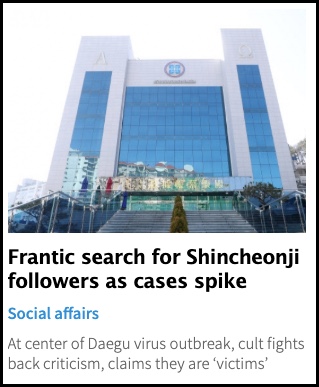
Feb. 23: More Than 50% of South Korea's 433 Coronavirus Cases Linked to Shincheonji Cult Whose Leader Believes He's Immortal (Daily Mail)
Feb. 24: Infected Health Official Leading South Korea's Fight Against Covid-19 is Member of Shincheonji Church of Jesus Doomsday Cult (South China Morning Post)
Feb. 24: Secretive Church Sect At The Center Of South Korea's Coronavirus Outbreak (NPR)
Feb. 24: More Than 550,000 Sign Petition to Dissolve Shincheonji by Force (The Korea Herald)
Feb. 24: Shincheonji Stokes Public Anger For 'Acting as Victim' (The Korea Times)
Feb. 24: How South Korea's Coronavirus Outbreak Got so Quickly Out of Control (Steven Borowiec for Time Magazine)
Feb. 24: 'Stigmatizing Would Drive Shincheonji Believers Into Ground' (Oh Young-jin for The Korea Times)
Feb. 24: Police to Hunt Down Infected Sect Members (Chosun Ilbo)
Feb. 24: South Korea Orders Temporary Shutdown of Messianic Church Linked to More Than Half The Country's Coronavirus Cases (The Washington Post)
Feb. 24: Religious Community Struggles to Prevent Further Coronavirus Infections (Yonhap News)
Feb. 24: 'It's Ruining Everyone': Eerie Quiet Reigns in Coronavirus-Hit South Korean City (Nemo Kim for The Guardian)
Feb. 23: 'Crazy Auntie' & Secretive Church at Heart of Spike of Coronavirus Cases in South Korea (The Strait Times)
QuoteHe also recalled spending a lot of time in church on weekdays, joining small groups to study the Bible in crowded, confined spaces. Another former member, who left the church in 2015, told the New York Times that they were trained to sing hymns loudly and not wear anything on their faces, such as glasses or masks. They were also trained not to fear illnesses, he added.
"We were taught not to care about such worldly things like jobs, ambition or passion. Everything was focused on proselytising, even when we were sick."
Feb. 23: More than Half S. Korean Coronavirus Infections Linked to Shincheonji (Yonhap News)
Feb. 23: 4-Year-Old Becomes Youngest COVID-19 Patient - Nursery Teacher is Shincheonji Member (The Korea Herald)
Feb. 23: 'Super-Spreader' Aunty & A Cult Has South Korea On Its Toes As Coronavirus Cases Multiply Mysteriously (India Today)
Feb. 23: Frantic Search for Shincheonji Followers as Cases Spike (The Korea Herald)
Note: Article title changed post publication to "Shincheonji Says is Fully Cooperating". The original title was later viewable on the Korea Herald's homepage and is searchable.
QuoteThe Daegu Metropolitan Police Agency mobilized some 600 officers to locate those followers who are still unaccounted for. The group's spokesperson said they (typo? there) were about 260 who are out of touch.
Feb. 23: More Than 50% of South Korea's 433 Coronavirus Cases Linked to Shincheonji Cult Whose Leader Believes He's Immortal (Daily Mail)
Feb. 24: Infected Health Official Leading South Korea's Fight Against Covid-19 is Member of Shincheonji Church of Jesus Doomsday Cult (South China Morning Post)
Feb. 24: Secretive Church Sect At The Center Of South Korea's Coronavirus Outbreak (NPR)
Feb. 24: More Than 550,000 Sign Petition to Dissolve Shincheonji by Force (The Korea Herald)
Feb. 24: Shincheonji Stokes Public Anger For 'Acting as Victim' (The Korea Times)
Feb. 24: How South Korea's Coronavirus Outbreak Got so Quickly Out of Control (Steven Borowiec for Time Magazine)
Feb. 24: 'Stigmatizing Would Drive Shincheonji Believers Into Ground' (Oh Young-jin for The Korea Times)
Feb. 24: Police to Hunt Down Infected Sect Members (Chosun Ilbo)
QuotePolice in Daegu formed a special taskforce on Sunday to locate over 600 Shincheonji members who are believed to have come into contact with the 31st confirmed case of infection, who is considered a "supercarrier," but have gone to ground without responding to phone calls and text messages from health officials.
Feb. 24: South Korea Orders Temporary Shutdown of Messianic Church Linked to More Than Half The Country's Coronavirus Cases (The Washington Post)
QuoteThe church denied reports that members were told to lie about recent services. The church said it was not an official order from the leadership but a "personal message" from one member. ...
The Korea Centers for Disease Control and Prevention said the woman initially refused doctors' requests that she be tested for the virus on the grounds that she had not traveled abroad recently. The church denied media reports that the woman assaulted nurses and created a commotion with fellow church members at the hospital.
Feb. 24: Religious Community Struggles to Prevent Further Coronavirus Infections (Yonhap News)
Feb. 24: 'It's Ruining Everyone': Eerie Quiet Reigns in Coronavirus-Hit South Korean City (Nemo Kim for The Guardian)
#5
Shincheonji: The Cult Of Lee Man-hee: Articles, Links & Resources / Re: Lee Man-hee & Shincheonji:...
Last post by Peter Daley - October 05, 2026, 01:51:48 PMI'm reorganizing the early Covid links, looking for dead links and later, some quotes.
February 19-22, 2020
Feb. 19: Coronavirus: As 15 Cases Linked to Daegu Church Cluster, South Korea Warns Over Mass Gatherings (South China Morning Post)
Feb. 20: Coronavirus 'Super Spreader' at Church Services Raises Concerns of More Cases Coming (Yonhap News)
Feb. 20: Shincheonji, a Veiled Christian Sect, at Center of Virus Outbreak (The Korea Herald)
Feb. 20: Super Spreader: A Churchgoer Who Contacted Hundreds in Daegu & Seoul Before Quarantine (The Korea Times)
Feb. 20: South Korean 'Cult' at Center of Local Coronavirus Outbreak (Time)
Feb. 20: Daegu on Alert as Coronavirus Cases Surge (Yonhap News)
Feb. 21: In South Korea, Opaque Sect Draws Scrutiny With Virus Spike (Bloomberg)
Feb. 21: South Korean Cult Church Leader Says Coronavirus Outbreak is the 'Devil's Deed' (Strait Times)
Feb. 21: A Secretive 'Cult' at Center of a Surge of Coronavirus Cases in South Korea (LA Times)
Feb. 21: Fact Check: COVID-19 Breakout in South Korea Traced to Shincheonji Church Cult (International Business Times)
Feb. 21: In Korea's Viral 'Hot Zone,' A Quiet Fear Reigns (Andrew Salmon for Asia Times)
Feb. 21: Shadowy Church Is at Center of Coronavirus Outbreak in South Korea (The New York Times)
Feb. 21: Seoul City to Ban Rallies in Central Seoul, Close Shincheonji Seoul Facilities (The Korea Herald)
Feb. 21: Moon Calls for Inspection of Shincheonji Church of Jesus in Relation to COVID-19 (The Korea Herald)
Feb. 21: South Korea is Bracing for a Spike in Coronavirus Cases After a 'Super-Spreader' Event Occurred at a Church 'Cult' (Business Insider)
Feb. 21: Coronavirus: South Korean Sect Identified as Hotbed (BBC News)
Feb. 21: Coronavirus Outbreak in South Korea Linked to Shincheonji Christian Sect (ABC Australia)
Feb. 22: In South Korea, Coronavirus Meets the Second Coming (Donald Kirk for The Daily Beast)
Feb. 22: In South Korea, Coronavirus Meets the Second Coming (Donald Kirk for The Daily Beast)
One article missing due to accidental deletion - check original thread.
Feb. 22: South Korea Screens Thousands of Religious Sect Members for Coronavirus (The Guardian)
Feb. 22: S. Korea's Virus Cases Surge to 433 on Church Services, Cluster Outbreak at Hospital (Yonhap News)
February 19-22, 2020
Feb. 19: Coronavirus: As 15 Cases Linked to Daegu Church Cluster, South Korea Warns Over Mass Gatherings (South China Morning Post)
Feb. 20: Coronavirus 'Super Spreader' at Church Services Raises Concerns of More Cases Coming (Yonhap News)
Feb. 20: Shincheonji, a Veiled Christian Sect, at Center of Virus Outbreak (The Korea Herald)
Feb. 20: Super Spreader: A Churchgoer Who Contacted Hundreds in Daegu & Seoul Before Quarantine (The Korea Times)
Feb. 20: South Korean 'Cult' at Center of Local Coronavirus Outbreak (Time)
Feb. 20: Daegu on Alert as Coronavirus Cases Surge (Yonhap News)
Feb. 21: In South Korea, Opaque Sect Draws Scrutiny With Virus Spike (Bloomberg)
Feb. 21: South Korean Cult Church Leader Says Coronavirus Outbreak is the 'Devil's Deed' (Strait Times)
Quote"This disease case is seen as the devil's deed to stop the rapid growth of Shincheonji," he wrote in the message, images of which were published by Yonhap news agency.
Feb. 21: A Secretive 'Cult' at Center of a Surge of Coronavirus Cases in South Korea (LA Times)
Feb. 21: Fact Check: COVID-19 Breakout in South Korea Traced to Shincheonji Church Cult (International Business Times)
Feb. 21: In Korea's Viral 'Hot Zone,' A Quiet Fear Reigns (Andrew Salmon for Asia Times)
Feb. 21: Shadowy Church Is at Center of Coronavirus Outbreak in South Korea (The New York Times)
Quote"Her behavior is not surprising to people familiar with the church," said Chung Yun-seok, an expert on religious cults who runs the website Christian Portal News. "To them, getting sick is a sin because it prevents them from doing God's work."
Feb. 21: Seoul City to Ban Rallies in Central Seoul, Close Shincheonji Seoul Facilities (The Korea Herald)
Feb. 21: Moon Calls for Inspection of Shincheonji Church of Jesus in Relation to COVID-19 (The Korea Herald)
Feb. 21: South Korea is Bracing for a Spike in Coronavirus Cases After a 'Super-Spreader' Event Occurred at a Church 'Cult' (Business Insider)
Feb. 21: Coronavirus: South Korean Sect Identified as Hotbed (BBC News)
Feb. 21: Coronavirus Outbreak in South Korea Linked to Shincheonji Christian Sect (ABC Australia)
Feb. 22: In South Korea, Coronavirus Meets the Second Coming (Donald Kirk for The Daily Beast)
Feb. 22: In South Korea, Coronavirus Meets the Second Coming (Donald Kirk for The Daily Beast)
One article missing due to accidental deletion - check original thread.
Feb. 22: South Korea Screens Thousands of Religious Sect Members for Coronavirus (The Guardian)
Feb. 22: S. Korea's Virus Cases Surge to 433 on Church Services, Cluster Outbreak at Hospital (Yonhap News)
#6
The Unification Church: Past & Present / Re: 2025/2026: Han Hak-ja's Ar...
Last post by Peter Daley - October 03, 2026, 11:09:06 AMOctober 2026
#7
The Unification Church: Past & Present / Re: The Washington Times & UPI
Last post by Peter Daley - September 30, 2026, 12:50:56 AMAug. 31: Mother Moon's Conviction Threatens Religious Liberty Worldwide - The Global War on Faith (Newt Gingrich for the UC-Owned Washington Times)
Aug. 31: Family Federation Spiritual Leader Jailed for Two Years in South Korea (Andrew Salmon for the UC-Owned Washington Times)
Trump's messages of support is mentioned in at least one other article by Andrew that I recall, but neither included any mention of the payments by the UC for those endorsements...
Related: July 14, 2023: Lucrative Speaking Fees for Donald & Melania Trump Revealed in Revised Personal Financial Disclosure Filing (CNN)
Sept. 3: How the UC Could Help Reconcile The Two Koreas (Joseph R. DeTrani for The UC-Owned Washington Times)
Aug. 31: Family Federation Spiritual Leader Jailed for Two Years in South Korea (Andrew Salmon for the UC-Owned Washington Times)
QuoteThe church, which seeks the unification of Christian and other religions worldwide, has often drawn unfavorable attention in the U.S. for some of its practices, including mass weddings, but has enjoyed support from conservative political figures in the West. President Trump and former U.S. House Speaker Newt Gingrich, among others, have spoken at federation-backed conferences. ...
The revelations linking Japanese lawmakers to the church revitalized a long legal campaign waged against the federation by a lawyers' group representing people who said their families had been coerced into donating to the church. The church responded that many donations — including half of those made by the mother of Mr. Abe's murderer — had been returned. It also said that practices such as "spiritual sales" of pricey religious trinkets had been discontinued years prior.
Nothing availed. Despite not having broken any Japanese laws, the church was dissolved after its final appeal was overturned in June. The question now is whether the federation will face a similar onslaught in Korea.
Trump's messages of support is mentioned in at least one other article by Andrew that I recall, but neither included any mention of the payments by the UC for those endorsements...
Related: July 14, 2023: Lucrative Speaking Fees for Donald & Melania Trump Revealed in Revised Personal Financial Disclosure Filing (CNN)
QuoteTrump, who leads polls for the 2024 GOP presidential nomination, was paid a total of $2 million for speaking at two Universal Peace Federation World Summits in Bedminster, New Jersey, and Palm Beach, Florida. The group was established by the late Rev. Sun Myung Moon, the Korean evangelist and businessman who founded the Unification Church, and his wife, Hak Ja Han.
Sept. 3: How the UC Could Help Reconcile The Two Koreas (Joseph R. DeTrani for The UC-Owned Washington Times)
QuoteThe sentencing on Monday of Dr. Han — the federation's leader since the 2012 death of her husband — to two years in prison on bribery charges must have confounded the leadership in Pyongyang. ... One would hope that South Korean government would want to work with the Family Federation and UPF to reestablish a relationship with a hostile North Korea, given the excellent relationship UPF has with North Korea.
QuoteAmbassador DeTrani served over two decades with the CIA as a member of the Senior Intelligence Service.
#8
Stranger North Korean Things / Re: Beyond The Border: Life on...
Last post by Peter Daley - September 25, 2026, 12:31:21 PMSept. 18: Neighborhood Opposition Threatens Permanent School for NK Defector Children in Seoul (Korea JoongAng Daily)
Sept. 20: Seoul Pushes Ahead With School for NK Defectors (The Korea Herald)
Sept. 22: Two NK Members of Asian Games Seek Asylum in Japan (Reuters)
Sept. 24: Ukraine Sent Two Captured NK Soldiers to South Korea (Reuters)
Sept. 25: Lee Says Ukraine Breached Non-Disclosure Agreement on Two NK Soldiers (The Korea Times)
Sept. 25: Presidential Office: Ukraine Gave Advance Notice Before Announcing NKPOW Repatriation, but Seoul Opposed Disclosure (SBS)
Sept. 28: South Korea Demands Apology From Ukraine Over Disclosure of NK POW Transfer (CNN/Reuters)
Sept. 29: N. Korea Runs Alleged Secret Prison at Beijing Embassy (Yonhap News)
Sept. 20: Seoul Pushes Ahead With School for NK Defectors (The Korea Herald)
QuoteSome have also objected to placing Yeomyung School on the same site as facilities intended for young children. "A hands-on learning center for young children will be established on the site along with the Early Childhood Education and Promotion Center," the resident said. "If there is a school for North Korean defectors right next to the hands-on learning center, parents would be left apprehensive. What parent would send their children there?" ...
As Friday's town hall meeting grew heated, Yeomyung School principal Cho Myung-sook fell to her knees before residents and broke into tears.
Some residents also knelt in front of Cho during the confrontation, underscoring the intensity of the dispute over the school's relocation. Cho recalled the opposition the school encountered during its attempted relocation to Eunpyeong-gu in 2019 and expressed concern that students could again be hurt by the controversy surrounding their school. "I feel so sorry and worried that our students will be hurt again," Cho said.
Sept. 22: Two NK Members of Asian Games Seek Asylum in Japan (Reuters)
Sept. 24: Ukraine Sent Two Captured NK Soldiers to South Korea (Reuters)
Sept. 25: Lee Says Ukraine Breached Non-Disclosure Agreement on Two NK Soldiers (The Korea Times)
Sept. 25: Presidential Office: Ukraine Gave Advance Notice Before Announcing NKPOW Repatriation, but Seoul Opposed Disclosure (SBS)
Sept. 28: South Korea Demands Apology From Ukraine Over Disclosure of NK POW Transfer (CNN/Reuters)
Sept. 29: N. Korea Runs Alleged Secret Prison at Beijing Embassy (Yonhap News)
#9
The Unification Church: Past & Present / Re: The Washington Times & UPI
Last post by Peter Daley - September 25, 2026, 10:45:54 AMAug. 17: Seoul Slammed Over Weaponized Legal System Targeting Church Leaders, New Religions (Andrew Salmon for the UC-Owned Washington Times)
Well, this is why The Washington Times was founded. A lot to unpack; here are a few quotes from the latter part of the article:
Fun fact, the term "unholy alliance" was also used to describe the UC cozying up to Japanese politicians:
May 3, 2023: An Unholy Alliance: How the UC Penetrated Japan's Ruling Liberal Democratic Party (Nippon)
Well, this is why The Washington Times was founded. A lot to unpack; here are a few quotes from the latter part of the article:
Quote"Minorities, in particular religious minorities, are usually attacked in three stages," said Massimo Introvigne, co-founder of CESNUR and editor of religious-freedom publication Bitter Winter. He listed intolerance in media, discrimination from administrative authorities and, finally, persecution and violence.
"That applies to totalitarian and democratic states," he warned. The petition noted that the case against Mr. Lee "unfolds in a climate where media representations of Shincheonji as a 'cult' often rely on polemical accounts by religious opponents who denounce it as heresy." ...
The Family Federation, which promotes conservative family values, has always opposed communism. That has generated powerful enemies, some of whom may be coalescing. Liberal Japanese anti-Federation activists visited Daejon, Korea, in September to join a conference with Evangelical Christian pastors and a professor from China's National Police Academy who specializes in oversight of religious movements.
Mr. Introvigne dubs the emergent trilateral grouping an "Unholy Alliance." Beijing is officially atheist and permits only state-sanctioned religious activities. State agencies root out underground churches and have suppressed a new religion, Falun Gong.
In 2019, some hardline Korean Christian clergy cooperated with Beijing to compel the deportation of worshippers of an underground Chinese religion, the Church of Almighty God, who had escaped to Korea seeking asylum. ...
Mr. Introvigne suggests that the biggest bully pulpit now exists in the United States. "In the U.S, there is more awareness of the problems taking place in a country that is a fundamental regional ally of the U.S.," he said.
Fun fact, the term "unholy alliance" was also used to describe the UC cozying up to Japanese politicians:
May 3, 2023: An Unholy Alliance: How the UC Penetrated Japan's Ruling Liberal Democratic Party (Nippon)
#10
The Unification Church: Past & Present / Re: The Washington Times & UPI
Last post by Peter Daley - September 25, 2026, 10:44:09 AM2026
March 6: 'Dangerous Precedent' for Religious Freedom: Critics Assail Tokyo Court's UC Ruling (Ben Wolfgang and Andrew Salmon for the UC-Owned Washington Times)
Related 1:
March 4, 2023: Trump, Pompeo Celebrate Group With UC Ties (The Asahi Shimbun)
Related 2:
Oct. 26, 2023: UC-linked Group Paid Trump $2.5 mil. For Video Messages (The Mainichi Shimbun)
April 10, 2026: A Nobel Peace Prize for Religious Liberty (Massimo Introvigne for The Washington Times)
March 6: 'Dangerous Precedent' for Religious Freedom: Critics Assail Tokyo Court's UC Ruling (Ben Wolfgang and Andrew Salmon for the UC-Owned Washington Times)
QuoteReactions poured in from around the world in the hours after the ruling, which critics cast as an unprecedented legal step by the Japanese court. More important, they said, it could be the first domino to fall in an international crackdown on religious freedom.
"Unfortunately, this decision treads into territory that benefits opponents of a free society," former Secretary of State Mike Pompeo said in a statement. "Having worked with Japan extensively on security and human rights matters ... I worry this precedent will harm Japan's standing as a champion of freedom in Asia and potentially advance the interests of those working against our mutual dedication to human dignity and religious freedom."
Related 1:
March 4, 2023: Trump, Pompeo Celebrate Group With UC Ties (The Asahi Shimbun)
QuoteFormer U.S. President Donald Trump sent a one-minute video message to an event in Seoul organized by a group related to the Unification Church. The Universal Peace Federation opened its "Peace Summit 2023" in the South Korean capital on May 2. The event will run until May 6. ... Mike Pompeo, who was secretary of state in the Trump administration, attended the event in person and gave a speech at the podium.
Related 2:
Oct. 26, 2023: UC-linked Group Paid Trump $2.5 mil. For Video Messages (The Mainichi Shimbun)
QuoteFormer U.S. President Donald Trump received some $2.5 million from the Universal Peace Federation (UPF), a Unification Church affiliated group, to make video appearances on three occasions between 2021 and 2022, while former Vice President Mike Pence was paid $550,000 for speaking at a UPF event, the Mainichi Shimbun has confirmed by acquiring U.S. official records and checking them with court documents in Japan.
Meanwhile, the UPF has maintained that the group didn't pay former Prime Minister Shinzo Abe, who made a video appearance at its event in September 2021. If this is true, we must question why Abe agreed to speak for the event free of charge. In the video, Abe said he "highly appreciated" the Unification Church, formally called the Family Federation for World Peace and Unification, for its efforts to "place importance on the value of family." This video appearance is believed to have been one of the triggers for his assassination in July 2022.
April 10, 2026: A Nobel Peace Prize for Religious Liberty (Massimo Introvigne for The Washington Times)